Case 2
M57 Jean: employee data sent by email
Traced a request for staff names, salaries and SSNs to Jean's reply carrying m57biz.xls, using FTK Imager, Outlook and PowerShell. Disclosure is supported; impostor and publication are not proven.
Image verified
Confirmed
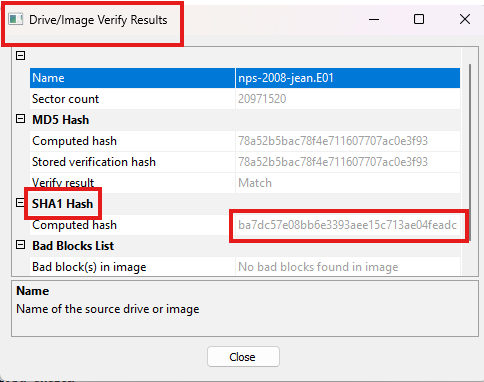
FTK Imager: the stored and computed MD5 of the E01 agree.
Shown in figures 1
Workbook
Confirmed
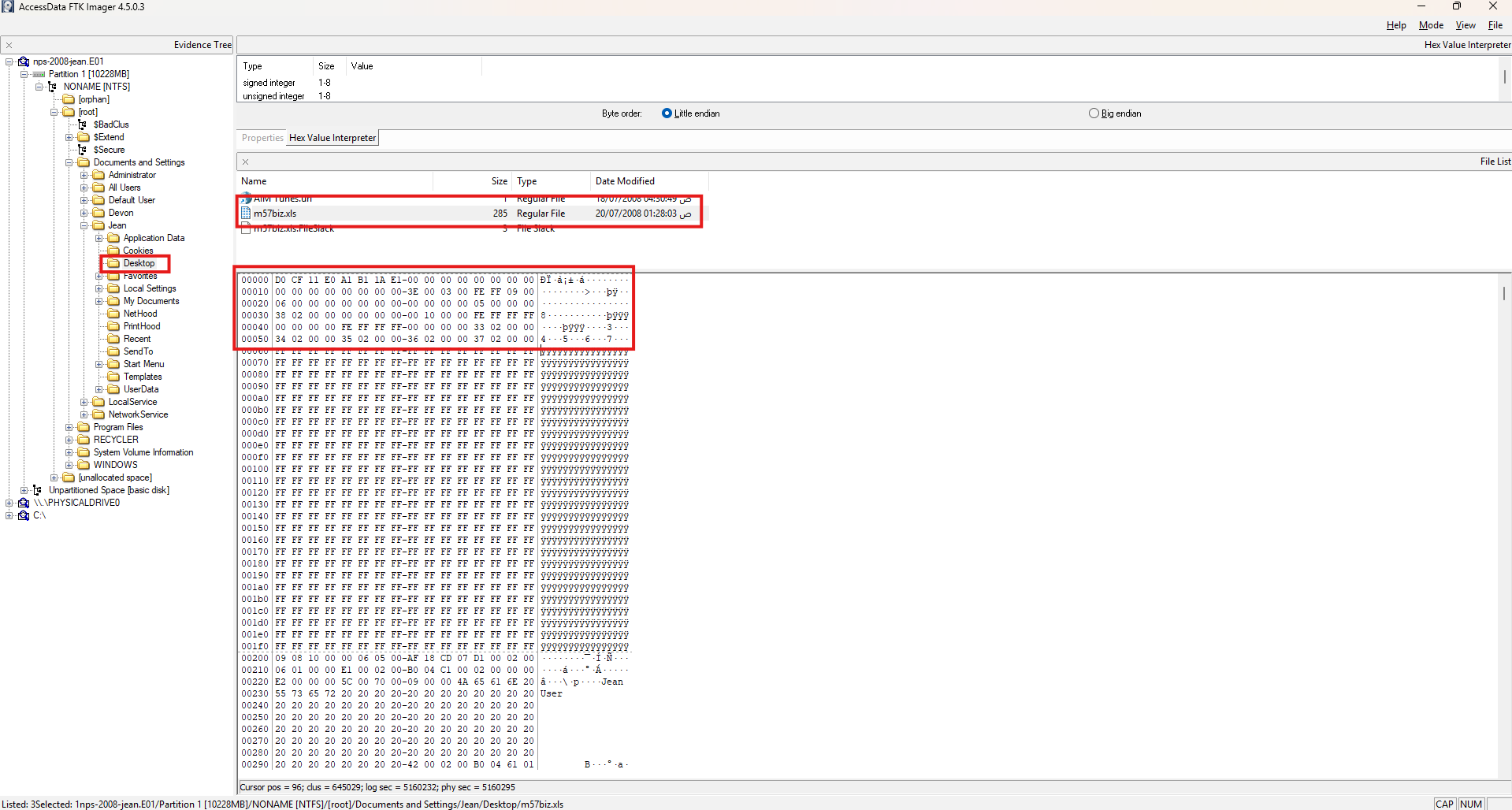
m57biz.xls on Jean's desktop holds names, salaries and SSNs.
Requested
Confirmed
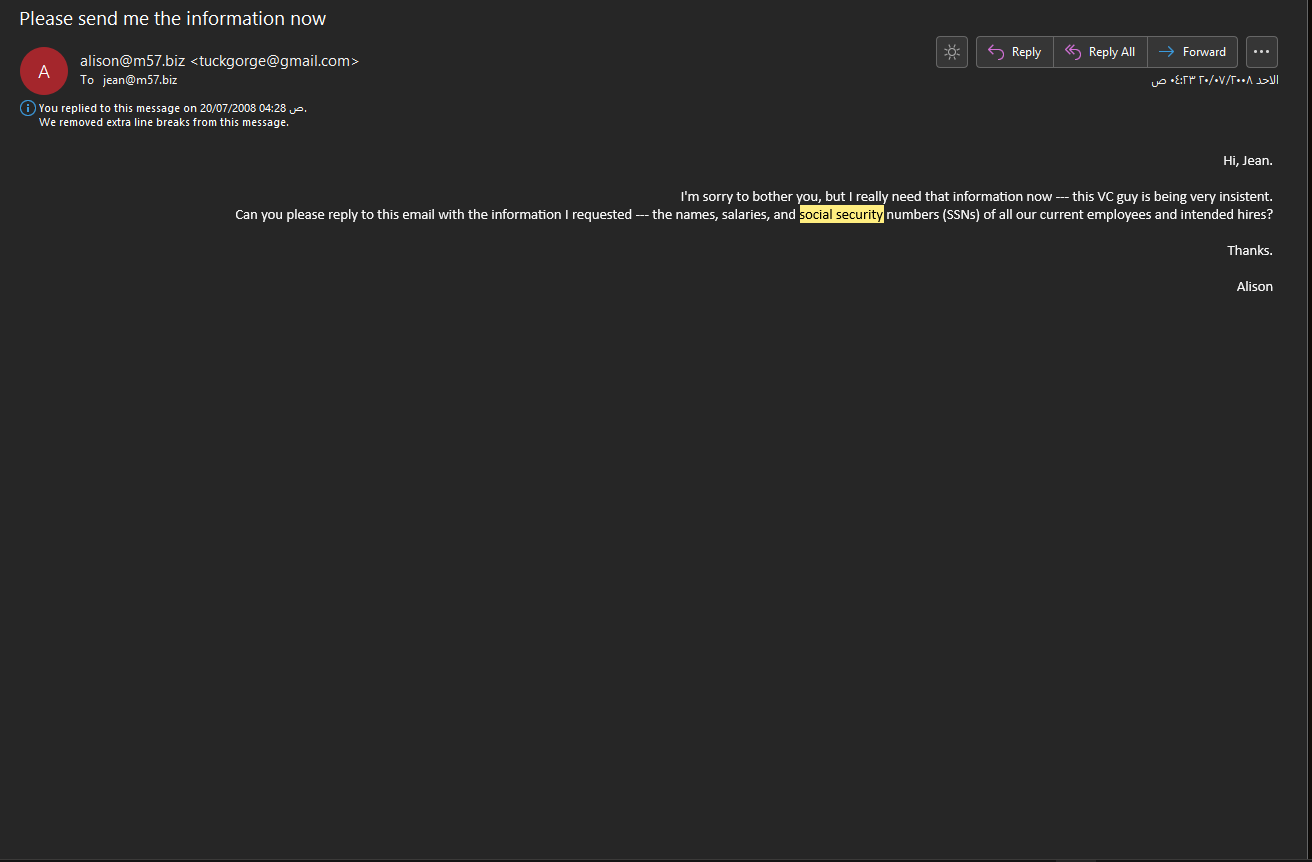
Mail shown as Alison, sent from a Gmail address, asks for the SSNs.
Shown in figures 4
Sent
Confirmed
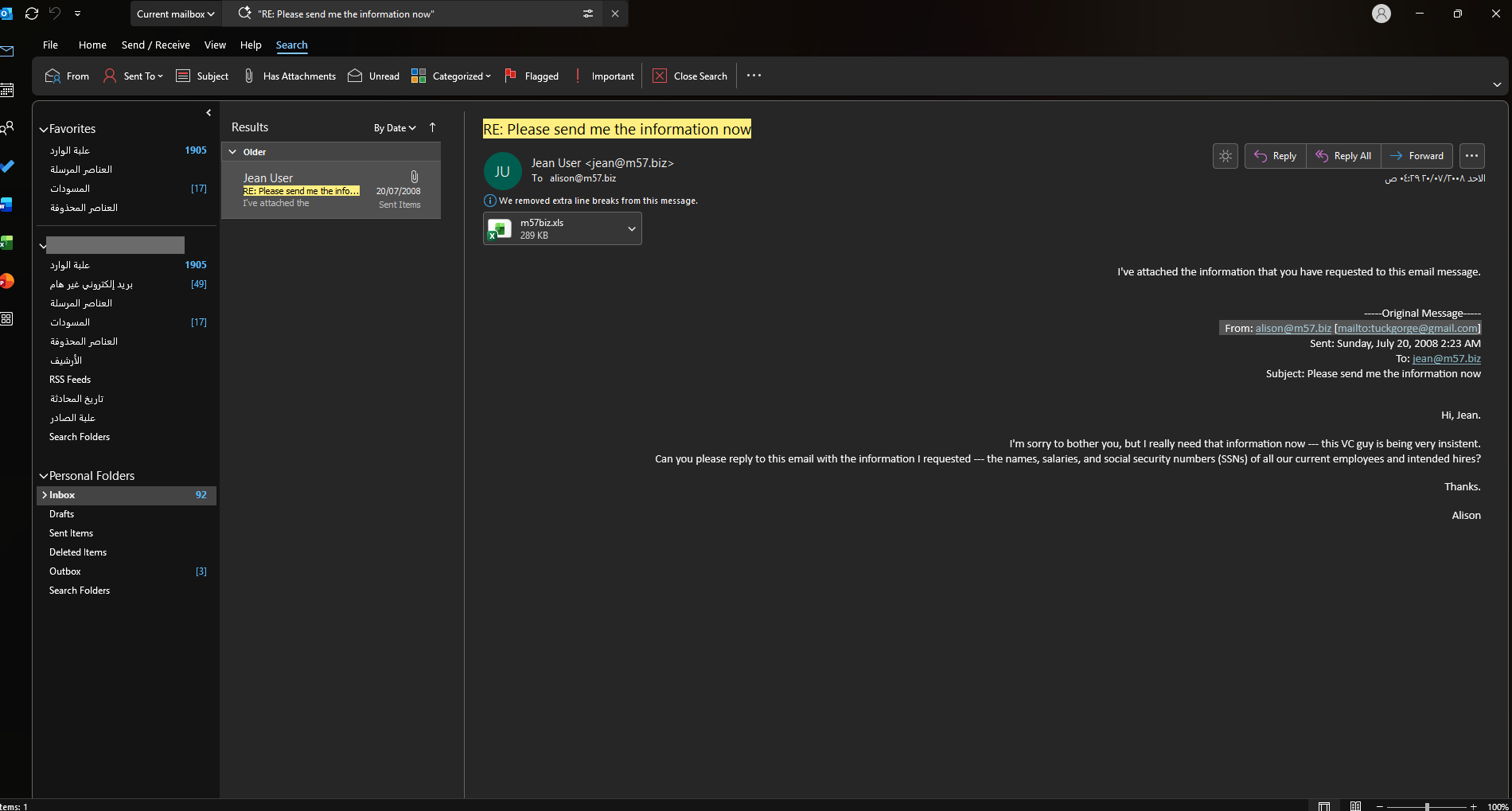
Jean's reply in Sent Items carries m57biz.xls.
Shown in figures 5
Acknowledged
Confirmed
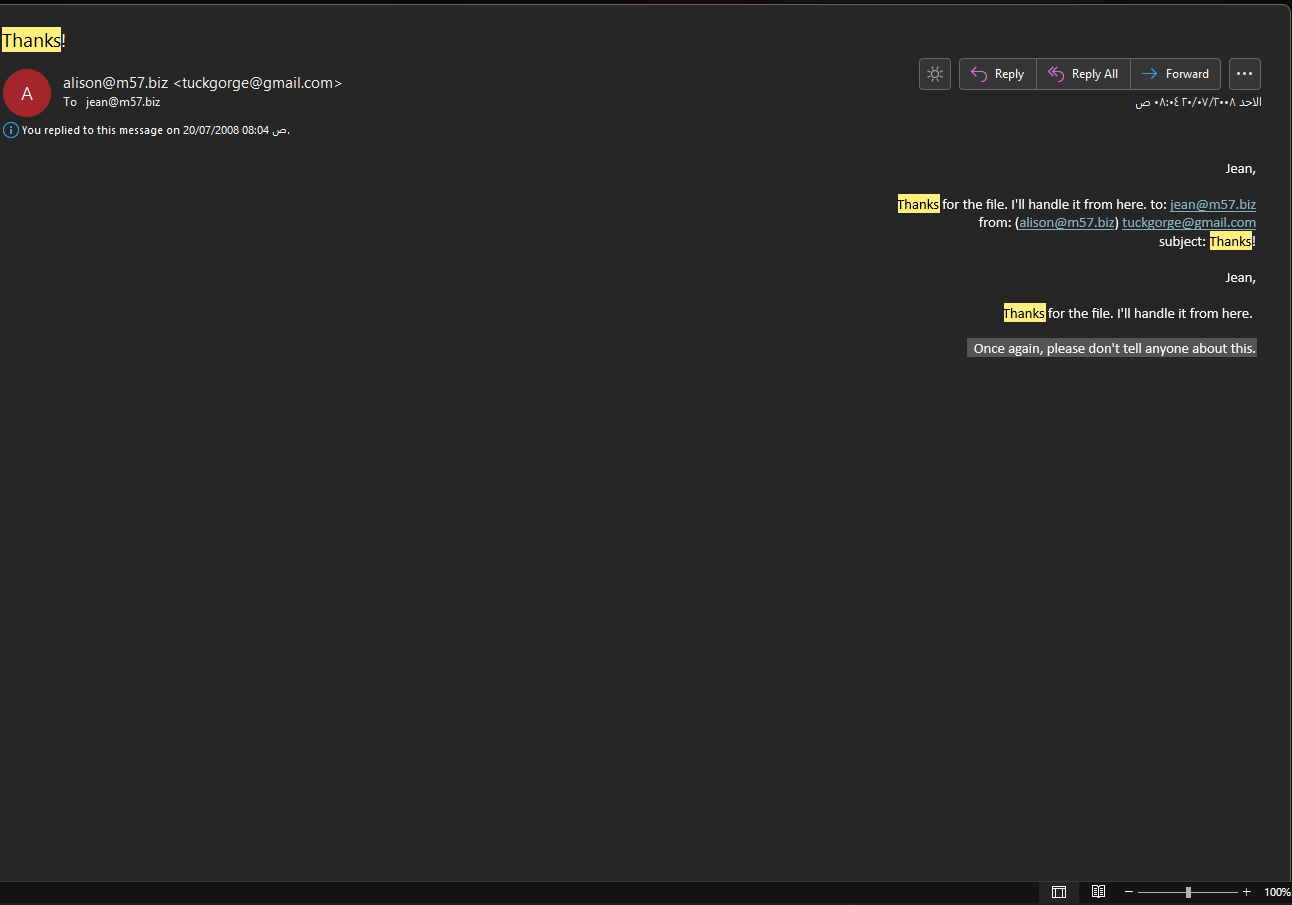
"Thanks for the file", with a request to tell no one.
Shown in figures 6
Impostor
Not proven
Who held the Gmail account, and any public posting, are not shown.
Case CASE-010: M57 Jean
Investigation of suspected employee-data disclosure through email. Evidence-led forensic examination; sensitive identifiers omitted.
| Item | Value |
|---|---|
| Examiner | Turki Adnan Abbas · تركي عدنان عباس |
| Case classification | Historical forensic training dataset; no claim of a contemporary live incident |
| Primary sources | Jean workstation E01 image; Jean Outlook PST; extracted Excel workbook; analyst screenshots |
Executive assessment
The examined material establishes a coherent sequence: an email purportedly from Alison requested employee names, salaries and Social Security numbers (SSNs); Jean sent a spreadsheet named m57biz.xls as an attachment; and a subsequent message using the same apparent external sender identity thanked Jean for the file and requested secrecy. The spreadsheet located on Jean’s desktop contains nine employee records, compensation figures and SSNs. A re-extracted copy and the comparison copy have identical SHA-256 hashes.
This supports a finding of high-risk transmission of sensitive corporate and personal data. The records do not independently establish the real identity of the requester, the final routing or receipt of the outbound attachment, or whether the data was publicly posted. Those questions remain open pending server-side evidence.
1. Examination scope and method
The workflow reviewed an E01 workstation image in FTK Imager, inspected the associated PST through Outlook and available indexed message views, traced the suspected conversation by subject and participants, inspected the spreadsheet in a controlled analysis copy, and compared SHA-256 digests of the original and re-extracted file. The source evidence was treated as read-only where possible. This report is a reasoned interpretation of the supplied artifacts and screenshots, not a substitute for a formal acquisition log or original mail-server records.
2. Evidence examined
| ID | Artifact | Provenance / observation |
|---|---|---|
| E-01 | nps-2008-jean.E01 | FTK Imager NTFS workstation image; verification dialog reports MD5 match and no bad blocks. |
| E-02 | outlook.pst | Archive mailbox opened in Microsoft Outlook; contains relevant inbox/sent messages. |
| E-03 | m57biz.xls | Jean desktop workbook visible within E01; contains personnel, salary and SSN fields. |
| E-04 | Re-extracted m57biz.xls | Analyst working copy; SHA-256 comparison returned MATCH. |
3. Investigation walkthrough
Step 01: Verify forensic image
Reported E01 MD5 (FTK verification): 78a52b5bac78f4e711607707ac0e3f93. The image-verification screenshot independently shows “Match” and “No bad blocks found in image.” The underlying image bytes were not supplied for a fresh independent hash calculation in this report.
Figure 1
FTK Imager verification of nps-2008-jean.E01: stored and computed MD5 agree; bad-block check is clear
Step 02: Locate workbook on Jean desktop
FTK Imager shows m57biz.xls at Documents and Settings / Jean / Desktop inside the NTFS partition. The file listing and hex view connect the filename to the examined workstation image. This discovery preceded the email correlation and the later analyst copy comparison.
Figure 2
FTK Imager discovery: Jean / Desktop / m57biz.xls, with file-list and hexadecimal context
Step 03: Extract and inspect workbook
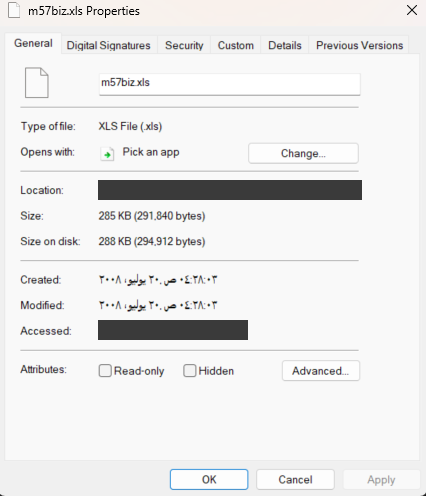
The extracted m57biz.xls workbook contains nine named employee rows, salary and role information, SSNs, and calculated payroll totals. Annual base salary totals $1,009,000; a 30% benefits allowance yields a modeled $1,311,700 annual cost. The following properties screenshot documents the analyst’s extracted copy in the CASE-010 analysis folder, rather than the original image location.
Figure 3
Properties of the extracted workbook in the analyst's CASE-010 analysis folder (path and access time redacted)
The analyst also photographed the opened worksheet. Its unredacted screenshot contains nine complete SSNs; the screenshot is retained as supporting case material but is excluded from this shareable report to prevent unnecessary disclosure. The workbook values are summarized above.
Step 04: Investigate the solicitation email
Outlook PST review identified a message addressed to Jean requesting employee names, salaries and SSNs of current and intended staff. The message invoked pressure from a venture-capital contact. Its displayed sender name suggested Alison, but its From field showed tuckgorge@gmail.com (alison@m57.biz). This discrepancy merits investigation without alone proving impersonation.
Figure 4
Original solicitation examined in Outlook; the request explicitly mentions SSNs
Step 05: Identify Jean’s reply with attachment
Sent Items contains “RE: Please send me the information now” from Jean to alison@m57.biz, with an attachment named m57biz.xls. The message confirms Jean attached the requested information. At this stage the name correlates with the workbook found on the desktop, but exact byte identity of the sent attachment still requires a separate PST export and hash comparison.
Figure 5
Sent Items email with m57biz.xls attached (examiner's mailbox account redacted)
Step 06: Trace acknowledgement and sender headers
The follow-up “Thanks!” message says, “Thanks for the file. I’ll handle it from here,” and asks Jean not to tell anyone. Its provided headers show the same Gmail/display-name construction as the original solicitation. This supports continuity of the conversation and an apparent acknowledgement; it is not equivalent to an SMTP delivery receipt or validated identity attribution.
Figure 6
Follow-up acknowledgement and secrecy request
Step 07: Check related messages and alternative explanations
Bob questioned whether a claimed online posting of his SSN was genuine. Carol warned that the website database was not ready for real data, and Jean denied using live data. These messages raise plausible follow-up hypotheses. No screenshot of the allegedly public page, web-server/database records, or independent evidence of publication was recovered in the provided materials.
Step 08: Compare original and extracted workbook hashes
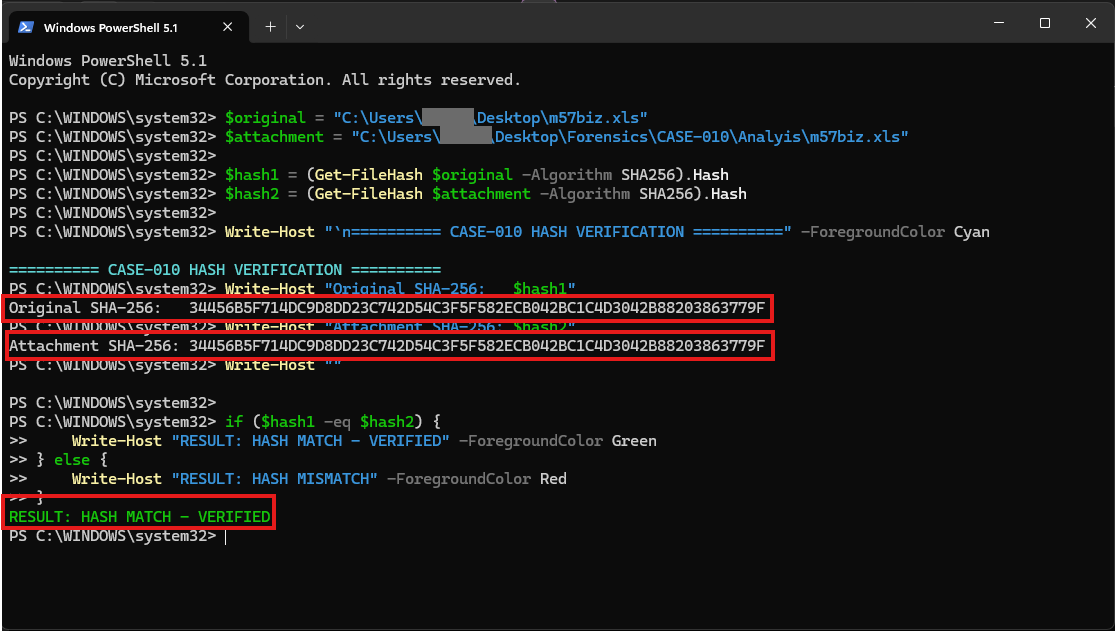
The analyst checked SHA-256 of the workbook copy and the freshly extracted copy in PowerShell. The two values matched; the initial comparison of a different intermediate copy had not matched, so it was not used as verified evidence.
| Evidence | SHA-256 (hex) |
|---|---|
| Original workbook / comparison copy | 34456B5F714DC9D8DD23C742D54C3F5F582ECB042BC1C4D3042B88203863779F |
| Re-extracted workbook | 34456B5F714DC9D8DD23C742D54C3F5F582ECB042BC1C4D3042B88203863779F |
| Outlook PST (supplied file) | E17B8C393FC3478C9A6BD59628D551798C4BF35D2A68AC891341DC611BBF1119 |
The matching workbook digests confirm byte-for-byte identity of those two analyzed copies. This is a post-discovery integrity check, not evidence of the outbound email’s eventual delivery.
Figure 7
Final PowerShell verification of both workbook copies showing SHA-256 MATCH (user name in paths redacted)
4. Reconstructed email event timeline
| Time / period | Event | Evidentiary status |
|---|---|---|
| 20 Jul 2008, 01:22:45 UTC | “Please send me the information now” arrives requesting personnel data. | Full Internet header and message body. |
| 20 Jul 2008, after request | Jean replies with m57biz.xls attachment. | Outlook Sent Items; SMTP delivery not independently verified. |
| 20 Jul 2008, 05:03:40 UTC | “Thanks!” is received; sender acknowledges file and asks for secrecy. | Full Internet header and message body. |
| 21 Jul 2008 (message view) | Bob and Carol raise possible data-exposure and database concerns. | Suspicion only; no published data or database record acquired. |
Times for the two received messages are converted from PDT (UTC−07:00) headers to UTC. Jean’s exact SMTP submission time is not established.
5. Header interpretation and attribution limits
| Header observation | Supported interpretation / boundary |
|---|---|
| From: tuckgorge@gmail.com (alison@m57.biz) | The mailbox address and presented name differ. It is a suspicious identity cue, not proof of spoofing or actor ownership. |
| Return-Path: simsong@xy.dreamhostps.com | Envelope-related field of the archived message; do not equate it with the human sender. |
| Received: xy.dreamhostps.com → smarty.dreamhost.com → spunkymail-mx2 | Visible transport relays. 208.97.188.9 and 208.97.132.66/.74 are intermediary infrastructure, not proven origin endpoints. |
| Outbound To: alison@m57.biz | Displayed internal recipient; an external forward, mailbox rule, alias or actual downstream destination is not proven. |
6. Confidence and limitations
| Assessment | Confidence | Reason |
|---|---|---|
| Sensitive workbook existed on Jean workstation | High | File-system context and workbook inspection. |
| Jean sent a same-named workbook as attachment | High | Outlook Sent Items message and visible attachment. |
| Same bytes as the sent attachment | Not fully established | Need independent export/hash of PST attachment. |
| Gmail identity operated by an imposter | Undetermined | Display/From discrepancy; no identity verification. |
| Data became publicly accessible | Undetermined | Only reported concern; no public artifact or logs. |
Additional limitations: no native SMTP trace, authenticated mailbox audit, forwarding/alias configuration, sender-side mailbox, website/database image or complete verified chain-of-custody documentation was supplied. The FTK MD5 result is reported from an analyst screenshot, not independently recomputed here. The spreadsheet screenshot and workbook contain sensitive identifiers, intentionally withheld from this report.
7. Recommended next forensic actions
- Export the m57biz.xls attachment directly from the PST as a separate forensic derivative; compute SHA-256 and compare with the Jean desktop workbook.
- Acquire SMTP message-trace/delivery records, message identifiers, and alias/forwarding rules for alison@m57.biz and jean@m57.biz to establish the ultimate recipient.
- Review any available site backups, database snapshots, web-access logs and archival captures for evidence of publication; preserve original timestamps and URLs.
- Validate relevant user accounts, access permissions and sender identity through independent authorized organizational records.
- Maintain a repeatable acquisition and chain-of-custody log with evidence IDs, UTC timestamps, tool versions, hashes and examiner actions.
8. Conclusion
The artifact set strongly supports an attempted and apparently completed email-based disclosure of sensitive M57 personnel information: a targeted request, an outgoing workbook attachment, and a later acknowledgement asking for secrecy form a consistent evidentiary chain. Importantly, the record does not yet prove that the apparent Gmail sender was an unauthorized impersonator, that the outbound message reached an external mailbox, or that the data was published online. Those distinctions are material to any definitive breach determination.